Featured Guide: Understanding Executive Function in the Classroom.
Updated: Mar 27

Have you ever heard a teacher describe a student as "bright, but unorganized"? Or perhaps you’ve seen a child who can memorize every detail of a video game but cannot remember to bring their homework from their backpack to their desk.
At Unlocked Self Counseling PLLC, we often find that what looks like "laziness" or "defiance" in the classroom is actually a struggle with Executive Function.
What is Executive Function?
Think of Executive Function as the "Air Traffic Control" system of the brain. It is the set of mental skills that help us manage our time, pay attention, and switch focus. For neurodivergent students—especially those with ADHD, Autism, or Dyslexia—this air traffic control system may be under-resourced or wired differently.
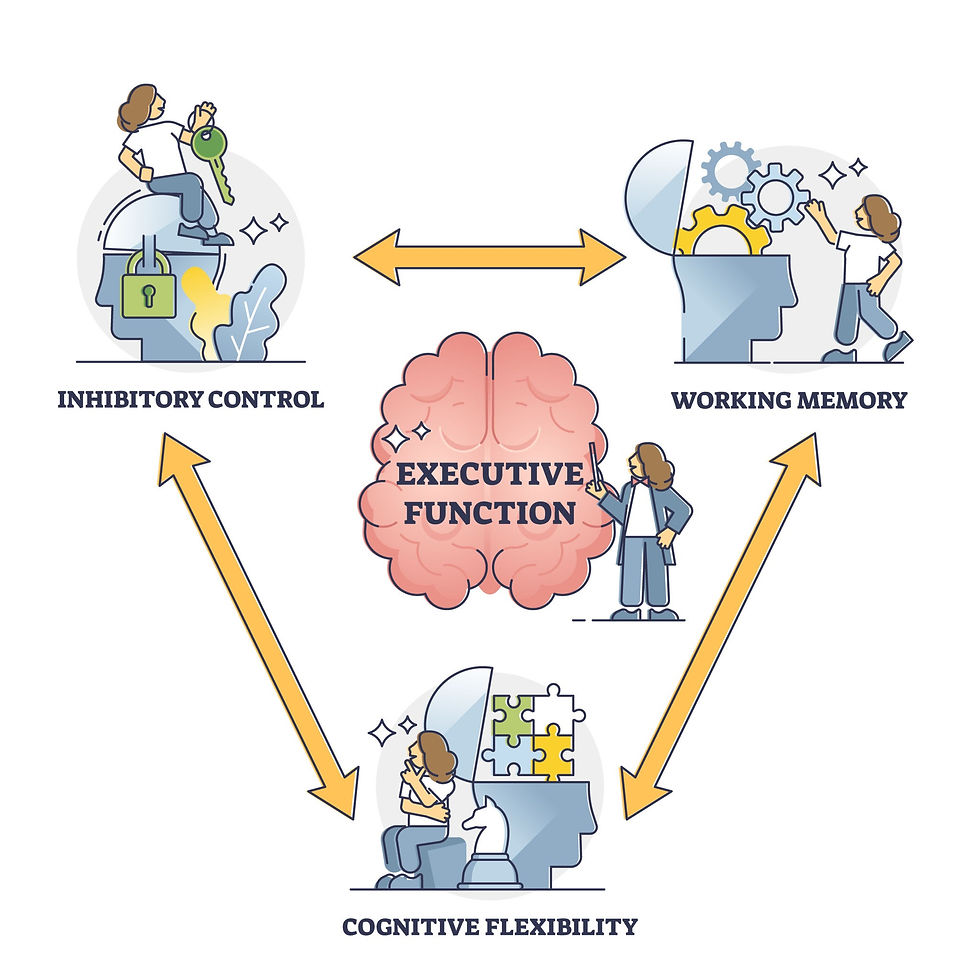
The 8 Core Pillars of Executive Function
To "unlock" a student's potential, we first have to identify which "control tower" needs more support.
Skill | How it looks in the classroom |
Impulse Control | Blurting out answers or touching things before thinking. |
Emotional Control | Meltdowns when a task gets hard or a grade is lower than expected. |
Flexible Thinking | Getting "stuck" when a routine changes or a new rule is introduced. |
Working Memory | Forgetting the second half of a three-step instruction. |
Self-Monitoring | Not realizing their behavior is affecting others or their own work. |
Planning & Prioritizing | Knowing they have a book report due but having no idea how to start. |
Task Initiation | Sitting for 20 minutes staring at a blank page, unable to write the first word. |
Organization | The "Black Hole" backpack—lost assignments and crumpled papers. |
Moving from "Will" to "Skill"
One of the most important shifts a parent or teacher can make is realizing that executive function challenges are a matter of skill, not will. A student isn't refusing to start their work; their brain’s "task initiation" switch is stuck.
When we view these behaviors through a neuro-affirming lens, we stop asking "Why won't you?" and start asking "How can I help you?"
Practical Classroom Strategies (The "Keys" to Success)
Supporting the neurodivergent brain in a school setting involves externalizing what is usually internal.
1. Externalize Time
The neurodivergent brain often experiences "time blindness." Use visual timers (like the red-disk Time Timer) so the student can literally see time disappearing.
2. Externalize Instructions
Don’t rely on verbal multi-step directions. Use checklists, "First/Then" boards, or visual rubrics. If a student has to use their "Working Memory" just to remember the rules, they won't have enough brainpower left to do the actual work.
3. The "Body Double" Technique
Sometimes, a student just needs a regulated person nearby to help them initiate a task. This isn't "hand-holding"—it’s providing a calm nervous system for the student to "sync" with until their own "task initiation" kicks in.
4. Break it Down (The Rule of 3)
A giant project is a mountain. Turn it into three small hills. Instead of "Write your essay," try: "1. Open the document. 2. Write the title. 3. List three ideas."
How Unlocked Self Counseling Can Help
As a Licensed Professional Counselor, Jeremy Gwizdalski works directly with families to develop these skills. Through a combination of Cognitive Behavioral Therapy (CBT) and specialized executive function coaching, we help students move from "stuck" to "unlocked."